
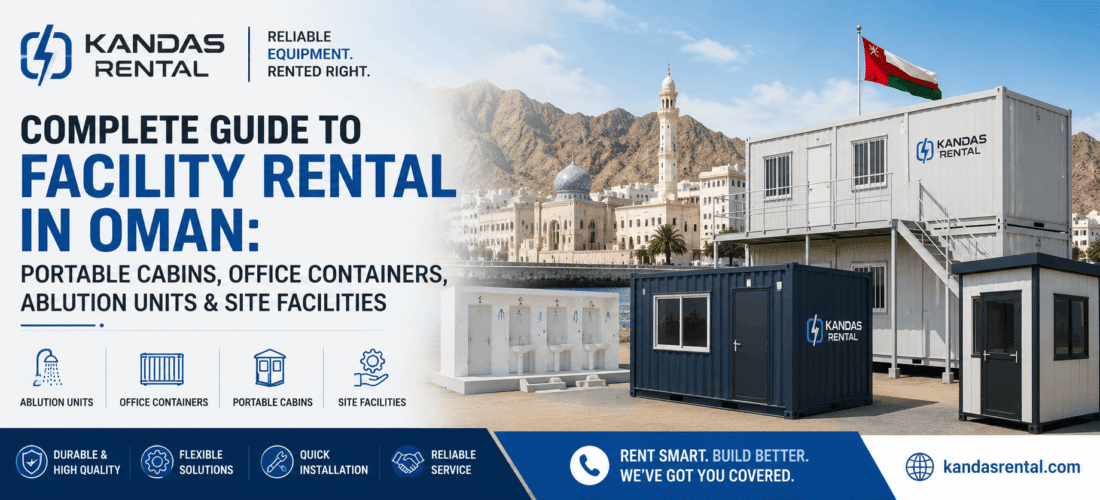
Construction, oil and gas, infrastructure, industrial, and remote projects often need functional facilities before permanent infrastructure is available. Building permanent structures may not be practical when a project has a limited timeline, temporary workforce, or changing site requirements.
Facility Rental in Oman provides a flexible solution by giving project teams access to temporary offices, portable cabins, ablution units, security cabins, pantry facilities, and other site infrastructure without the commitment of permanent construction.
This guide explains the main types of temporary facilities, how to choose them, and what project managers should consider before renting.
What Is Facility Rental?
Facility rental is the provision of temporary, ready-to-use structures and site facilities for a specific project or rental period. These units can be delivered to a worksite, installed for use, maintained when required, and relocated or removed when the project is completed.
Depending on the project, temporary facilities can be used for:
- Site offices
- Worker welfare areas
- Toilets and washing facilities
- Security and access control
- Pantry and kitchen facilities
- Meeting rooms
- Remote workspaces
- Project administration
Quick Guide to Temporary Facilities
| Facility | Primary Purpose | Suitable For |
| Portable Ablution Unit | Toilets and washing | Construction sites, camps and remote projects |
| Office Container | Workspace and administration | Construction and industrial projects |
| Portable Cabin | Flexible temporary space | Remote sites and project facilities |
| Security Cabin | Access control and monitoring | Construction and industrial sites |
| Kitchen/Pantry Facility | Food preparation and welfare | Camps and remote worksites |
The right combination depends on workforce size, project duration, site conditions, available space, and required facilities.
Why Are Temporary Facilities Important in Oman?
Oman’s construction and industrial activities can involve remote locations, desert environments, infrastructure projects, and sites where permanent buildings are unavailable. In these situations, temporary facilities help companies establish essential workspaces and welfare areas closer to their operations.
The climate is another consideration. Facilities used in Oman may need suitable insulation, ventilation, air conditioning, durable materials, and appropriate positioning to maintain comfortable working conditions.
For project managers, rental facilities can offer several practical advantages:
- Faster site setup
- Flexible rental periods
- Reduced need for permanent construction
- Easier relocation between work areas
- Scalable facilities as workforce requirements change
- Access to ready-to-use infrastructure
Types of Temporary Facilities
Portable Ablution Units
Sanitation is an essential requirement for construction sites, labour camps, industrial locations, and remote projects. Portable ablution units can provide toilets, wash basins, urinals, showers, freshwater storage, and sewage storage depending on the configuration.
Different sizes and layouts are available to accommodate varying workforce requirements. A compact unit may suit a smaller site, while larger configurations can support projects with a bigger workforce or more extensive sanitation requirements.
When selecting an ablution unit, consider:
- Number of users
- Number of toilets and wash facilities required
- Project duration
- Available installation space
- Water and sewage arrangements
- Cleaning and servicing requirements
- Need for showers or additional welfare facilities
Office Containers
A temporary office gives project managers, engineers, supervisors, and administrative teams a dedicated workspace close to the worksite.
Office containers can support:
- Project administration
- Site supervision
- Engineering activities
- Meetings
- Document management
- Staff coordination
The required size depends on the number of users and how the space will be used. For larger teams, a 40-foot configuration may provide more usable space, while a 20-foot unit can be suitable for smaller operations.
Some configurations can also combine office, pantry, and toilet facilities, helping create a more self-contained workspace.
Portable Cabins
Portable cabins provide flexible temporary space for applications that do not require a full-size office container. Depending on the configuration, they can be used for site administration, security, welfare, storage, or other project-specific purposes.
They are particularly useful when a project needs a dedicated space that can be installed and relocated as work progresses.
Security Cabins
A security cabin provides a designated location for security personnel and access-control activities. It can be positioned near an entrance or strategic access point to support visitor management and site monitoring.
When selecting a security cabin, consider:
- Visibility from the entrance
- Number of security personnel
- Available site space
- Access to electricity and cooling
- Door and window positioning
- Expected operating hours
Kitchen and Pantry Facilities
Remote projects may require dedicated areas for food preparation, storage, and staff welfare. Temporary kitchen or pantry facilities can help project teams establish practical food-service areas without constructing a permanent building.
For larger camps, these facilities can be planned alongside offices, sanitation units, accommodation, and other welfare infrastructure.
How to Choose the Right Facility
Choosing a temporary facility should start with the project’s requirements rather than simply selecting the largest available unit.
1. Assess Workforce Size
Determine how many employees, contractors, visitors, and security personnel will use each facility. This is especially important when planning sanitation and office capacity.
2. Consider Project Duration
Short-term projects may require compact facilities with quick deployment, while longer projects may benefit from larger configurations and additional amenities.
3. Check Site Accessibility
Confirm that delivery vehicles can reach the installation area and that sufficient space is available for positioning, servicing, and eventual removal.
4. Identify Required Functions
Decide whether you need an office, sanitation unit, security facility, kitchen, pantry, or a combination of several facilities.
5. Consider Oman’s Climate
For outdoor projects, evaluate air conditioning, insulation, ventilation, shading, and durable construction. Proper site positioning can also improve comfort and usability.
6. Plan for Future Changes
If workforce numbers or project locations may change, choose facilities that can be expanded, relocated, or adjusted without disrupting operations.
Which Facility Should You Choose?
A simple decision framework can make the selection process easier:
Need a workspace? → Choose an office container.
Need toilets, washing or shower facilities? → Choose an ablution unit.
Need a small flexible site structure? → Consider a portable cabin.
Need controlled site access? → Use a security cabin.
Need food preparation or pantry space? → Consider a kitchen or pantry facility.
Need several functions at one location? → Consider combined office, pantry, and toilet configurations.
This approach helps project managers match the facility to the actual operational requirement instead of selecting a product based only on size.
Temporary Facilities vs Permanent
Construction
Permanent construction can make sense for long-term developments, but temporary rental facilities can be more practical when infrastructure is required only for a specific project phase.
Rental solutions can reduce the need to invest capital in structures that may have limited use after project completion. They can also provide greater flexibility when project locations, workforce numbers, or operational requirements change.
For example, a contractor may initially require a small office and sanitation facility and later add larger or additional units as the workforce increases.
Combining Facilities with Equipment
Temporary facilities are only one part of a functioning worksite. Construction and industrial projects may also need power generation, compressed air, lighting, welding equipment, or dewatering solutions.
Companies evaluating heavy equipment rental companies in Oman should look beyond individual equipment availability and consider factors such as fleet range, equipment condition, maintenance, delivery capability, rental flexibility, and technical support.
A rental provider with both equipment and facility solutions can simplify project coordination by allowing multiple site requirements to be managed through one supplier.
Facility Rental for Different Industries
Temporary facilities can support a wide range of projects, including:
Construction
Site offices, sanitation facilities, security cabins, and welfare spaces can be deployed close to active construction zones.
Oil and Gas
Remote operations may require offices, sanitation, kitchens, and other temporary infrastructure where permanent facilities are unavailable.
Infrastructure
Road, bridge, utility, and other infrastructure projects can use relocatable facilities as work progresses from one location to another.
Industrial Projects
Manufacturing, maintenance, and engineering projects may need temporary offices and welfare facilities during shutdowns, expansions, or major project phases.
Remote Worksites
Temporary facilities provide practical infrastructure where access to established buildings and services is limited.
What Should You Check Before Renting?
Before finalizing a rental, confirm:
- Facility dimensions and layout
- Number of intended users
- Available site space
- Delivery and installation requirements
- Electrical requirements
- Air conditioning and ventilation
- Water and sewage arrangements
- Cleaning and maintenance
- Rental duration
- Relocation requirements
- Emergency or replacement support
Clarifying these details in advance can prevent delays and ensure the selected facility is appropriate for the worksite.
Why Choose Kandas Rental?
Kandas Rental provides temporary facility solutions for construction and industrial requirements across Oman. Its facility portfolio includes portable ablution units, office containers, portable cabins, security facilities, and office configurations with pantry and toilet facilities.
The company also provides equipment rental solutions that can complement temporary site infrastructure, allowing project teams to address multiple operational requirements through one rental partner.
When comparing rental providers, businesses should evaluate the range of available facilities, equipment condition, maintenance practices, delivery support, rental flexibility, and ability to meet project-specific requirements rather than choosing solely on price.
Conclusion
Temporary facilities provide an efficient way to establish essential infrastructure for construction, industrial, oil and gas, infrastructure, and remote projects in Oman.
Portable ablution units address sanitation requirements, office containers provide dedicated workspaces, portable cabins offer flexible temporary space, security cabins support controlled access, and kitchen or pantry facilities help meet worker welfare requirements.
The best solution depends on workforce size, project duration, site accessibility, climate conditions, required functions, and future relocation needs. By assessing these factors before renting, project managers can create a practical temporary work environment while avoiding unnecessary investment in permanent structures.
Frequently Asked Questions
What does facility rental include?
Facility rental can include portable cabins, office containers, ablution units, security cabins, kitchen and pantry facilities, and other temporary structures required at project sites.
What is the best temporary facility for a construction site office?
An office container is generally suitable when a project needs a dedicated workspace for managers, engineers, supervisors, or administrative staff. The appropriate size depends on workforce numbers and space requirements.
How do I choose the right ablution unit?
Consider the number of users, required toilets and washing facilities, available space, project duration, water and sewage arrangements, and whether showers or additional welfare facilities are required.
Are temporary facilities suitable for remote projects in Oman?
Yes. temporary facilities can be particularly useful for remote construction, infrastructure, industrial, and oil and gas projects where permanent buildings or established site infrastructure may not be readily available.
Can office containers include pantry and toilet facilities?
Yes. some configurations combine an office with pantry and toilet facilities, creating a more self-contained temporary workspace.
How long can temporary facilities be rented?
Rental duration depends on the provider and project requirements. Short-term and longer-term arrangements may be available, so the rental period should be aligned with the project’s expected schedule.
What should I consider before renting a temporary facility?
Consider workforce size, facility purpose, dimensions, site access, climate conditions, utilities, servicing requirements, rental duration, delivery, and potential relocation.
Can temporary facilities be combined with equipment rentals?
Yes. facilities can be used alongside generators, air compressors, lighting towers, welding equipment, and dewatering solutions when a project requires additional temporary infrastructure and site equipment.
- August 17, 2026
- By:Febin
- Category:News
- no comments
Related Posts
- June 24, 2026
- By: Febin
- in: News




Post a Comment