
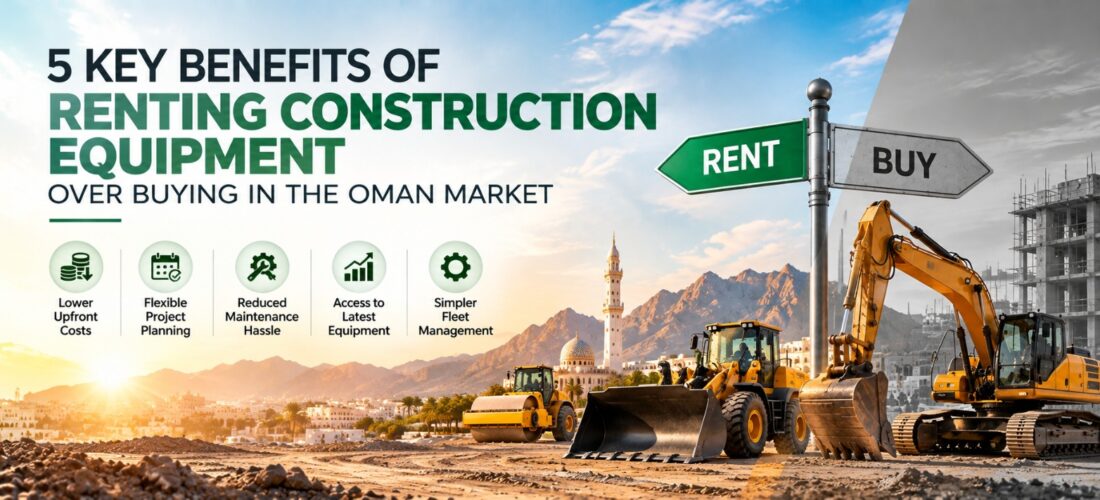
Construction projects in Oman often require different types of machinery at different stages. Buying every machine needed for a project can tie up capital in assets that may remain unused once the work is completed. Renting construction equipment in Oman provides a more flexible way to access the machinery required without taking on the full responsibilities of ownership.
For contractors, project managers and businesses managing changing project requirements, here are five key benefits of renting construction equipment instead of buying.
1. Reduce Upfront Capital Investment
Purchasing construction equipment requires significant capital before the equipment generates value for a project. This can place pressure on cash flow, particularly when several machines are required at the same time.
Rental allows businesses to pay for equipment according to the period it is required. The capital that would otherwise be tied up in machinery can remain available for materials, labour, transportation and other project expenses.
This makes Equipment Rental In Oman particularly useful for short-term projects, temporary requirements and businesses that want to expand their operational capacity without making a large equipment purchase.
2. Match Equipment to the Project, Not the Other Way Around
Equipment requirements can change considerably between excavation, installation, construction, maintenance and finishing activities. Buying machinery for every requirement can leave a business with equipment that is unsuitable or underused after a project phase ends.
Rental provides greater flexibility to select equipment based on the actual job requirement and rental duration.
Kandas Rental Oman provides equipment including air compressors, diesel generators, welding machines, lighting towers and dewatering pumps, supporting construction, infrastructure, industrial, oil and gas and other project requirements.
For businesses managing multiple projects, this flexibility can make it easier to scale equipment capacity up or down as work requirements change.
3. Reduce Maintenance and Equipment Management Responsibilities
Owning construction equipment means taking responsibility for regular servicing, inspections, repairs and keeping machinery ready for the next project. Unexpected maintenance can also create additional costs and operational delays.
With rental equipment, maintenance and equipment-readiness responsibilities can be handled by the rental provider according to the rental arrangement. Kandas states that its equipment is regularly maintained and inspected before deployment.
This can allow project teams to focus more on completing the work rather than managing an equipment fleet.
4. Avoid Paying for Equipment When It Is Sitting Idle
An owned machine continues to represent an investment even when it is not working. Storage, maintenance, depreciation and other ownership responsibilities continue between projects.
Renting changes this equation. Instead of building a fleet around the maximum equipment requirement of a project, businesses can bring in additional machinery when demand increases and return it when the requirement ends.
This project-based approach to equipment planning can be particularly useful for contractors working across projects with different schedules and equipment requirements.
5. Access the Right Equipment Without Building a Large Fleet
Construction companies may occasionally need specialised equipment that does not justify permanent ownership. Renting provides access to additional equipment without requiring a business to purchase and maintain every machine itself.
Kandas Rental offers flexible short-term, long-term and customised rental arrangements, along with delivery, maintenance and project-focused support.
For example, a contractor may require temporary power from generators, compressed air for industrial applications, lighting for night work or dewatering equipment for a specific phase of construction. Renting makes it possible to obtain these capabilities when required rather than keeping all of them in an owned fleet.
Renting vs Buying: Which Approach Fits Your Project?
Buying can make sense when equipment is used consistently across long-term projects and utilisation is high. However, renting can be more practical when equipment requirements are temporary, specialised or likely to change between projects.
The key is to consider how often the equipment will be used, how long it will be needed, the cost of ownership and how much flexibility your project requires.
For a broader understanding of rental strategies, equipment categories and applications, explore our Guide on Equipment Rental in Oman.
If you are looking for construction, industrial or project-specific machinery, explore Equipment Rental In Oman from Kandas Rental.
You can also explore Heavy Construction Equipment Rental in Oman for available equipment and rental solutions.




Post a Comment